

Understanding Entertainment Finance
Film and television productions incur significant costs during production, but many of the cash flows—performance-based revenue, advertising, tax credits, licensing payments etc.—are received later, often after completion.


Why Productions Need Capital
Upfront Costs
Production expenses are incurred during filming and post-production, well before tax credits and contracted payments are received.
Delayed Cash Flow
Tax credits, licensing payments, and other receivables are often monetized only after completion, audit, approval, or delivery.
market inefficiency
Traditional lenders often avoid the space due to its complexity and specialization, creating a persistent financing gap.

How Entertainment Finance Works
From Origination to Repayment
01
Production Company
Secures preliminary tax credit eligibility and contracted revenue.
Engages accounting partners and, where applicable, a completion bond.
02
Entertainment Finance Lender
Verifies collateral and underwrites receivables.
Structures a senior secured loan at a conservative advance rate.
Provides capital to bridge timing between costs and receivables.
03
Certified Accountants & Completion Bonds
Oversee production spend and ensure compliance with tax credit requirements.
Implement completion bond, where applicable, to support project delivery.
Manage audit and certification process for tax credit issuance.
04
Investors
Tax credits are issued after completion and audit, then sold or monetized to generate repayment proceeds.
Contracted payments are received according to their scheduled terms.
Investors are repaid from those defined collateral sources.
Illustrative Loan Structure
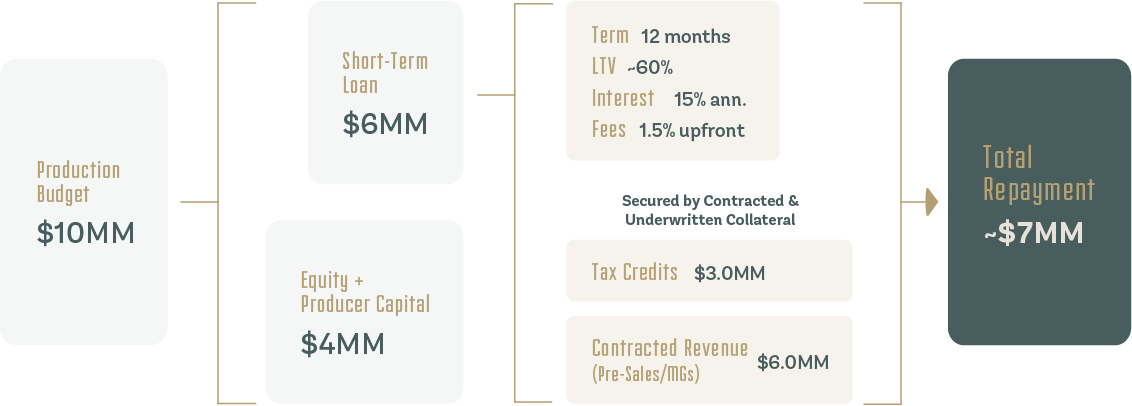
* Illustrative example for discussion purposes only. Terms, structure, collateral coverage and returns will vary by transaction.